Wednesday, May 10, 2023

Jobs for People With Disabilities | CAN DO WORK

Hi there! My name is Christine Matus of The Matus Law Group, and I’m excited to share our Heart to Heart series with you. This series is designed by our team of New Jersey special needs trust lawyers to educate and support families by connecting them with exceptional vendors, organizations, and individuals making a significant impact in the lives of those with special needs.

In this edition, we’re thrilled to introduce you to the founder of Can Do Work, Joe Nardini. Can Do Work is an incredible organization that is wholeheartedly committed to helping individuals with disabilities find meaningful and fulfilling employment opportunities that not only resonate with their unique strengths and capabilities but also foster their personal and professional growth.

Discovering Can Do Work: An Organization with a Mission

I first met Joe Nardini some time ago, and when he told me about his passion and drive to help individuals with disabilities, I knew I had to have him on this series. Joe’s background is in special education, and he has worked with the older age population transitioning into the job market. His organization, Can Do Work, aims to tap into the potential of these individuals and transform their disabilities into job-ready capabilities.

Why Form Can Do Work?

Joe started Can Do Work after decades of working in the system for other companies. He grew tired of the “good old boy and girl” system where the same big dollars went to the same household name companies every year, regardless of their performance. Joe’s approach to employment services is different. He quantifies his outcomes in ways that most other organizations don’t, taking a straight-line approach to employment just like anyone who graduated from college.

The Value of Can Do Work and its Impact on the Community

One of the most significant aspects of Can Do Work is the respect and equal treatment they offer to the individuals they serve. The families who have worked with Joe often express their gratitude for how he treats their loved ones like peers, providing them with the dignity and respect they deserve. Joe’s approach focuses on helping families with the type of benefits they truly need, and his dedication to making a difference in their lives is evident.

New Jersey ranks 16th in the country for having the most working-age youth and adults with disabilities who have marketable skills, want to work, can work, and deserve to work. Joe believes that the more people know about what Can Do Work can do, the more families they can help. By tapping into this untapped resource of American workers, Can Do Work not only helps individuals with disabilities find meaningful employment, but also contributes to the local, state, and national economies.

A Vision for the Future

In three to five years, Joe envisions having a storefront operation in each county in New Jersey. He also hopes to expand his services outside the state, solving problems for many more people. To achieve this, Joe is seeking benefactors to adopt this cause and make it a self-sustaining project. With the support of businesses and boardrooms, Can Do Work can continue to make a significant impact on the lives of individuals with disabilities and the communities they live in.

Transforming Lives Through Meaningful Employment Opportunities

People with disabilities have every right to pursue fulfilling and rewarding careers. As society continues to progress and become more inclusive, various job opportunities have opened up for individuals with different abilities. Employers are increasingly recognizing the unique skills and perspectives that people with disabilities bring to the workforce, leading to more diverse and accessible work environments. 

By raising awareness of organizations like Can Do Work and sharing their stories, we can encourage more employers to recognize the value and potential of individuals with disabilities. As a result, we can break down barriers and create equal opportunities for everyone, regardless of their abilities or limitations.

If you or a loved one are facing challenges related to disability and employment, don’t hesitate to reach out for assistance. At The Matus Law Group, our team of New Jersey special needs trust lawyers may be able to help you navigate the complex legal landscape and ensure that your rights are protected. Together, we can create a more inclusive and supportive workforce for people with disabilities. Contact us today at (732) 281-0060 to schedule a consultation.

Title Content
Can Do Work: Empowering Individuals with Disabilities Organization’s mission: Empowering individuals with disabilities for meaningful employment.
Founding Inspiration Joe Nardini’s background in special education and his drive to make a difference through Can Do Work.
Innovative Approach to Employment Services Unique approach: Quantifying outcomes, straight line employment path for individuals with disabilities.
Dignity and Respect Cornerstone: Treating individuals with disabilities respectfully, recognizing their capabilities.
Making an Impact Positive impact: Meaningful employment opportunities for individuals with disabilities, benefiting families and the economy.
A Vision for the Future Vision: Expansion of services, storefronts in each county, nationwide impact with benefactor support.
Advocating for Inclusivity and Equal Opportunities Role: Promoting inclusivity, breaking barriers, and creating equal opportunities for individuals with disabilities.


from Matus Law Group https://matuslaw.com/jobs-for-people-with-disabilities-in-new-jersey-can-do-work/

Is a Real Estate Purchase Agreement the Same as an Offer?

After tirelessly searching for the perfect home, you’ve finally found it! The next step is making an offer on the property. However, it’s important to remember that legally binding offers on real estate must be submitted in writing, not verbally. 

Before moving forward, it’s crucial to have your real estate purchase agreement carefully reviewed by an experienced New Jersey real estate lawyer. This ensures that the purchase agreement is comprehensive and serves your best interests. At Matus Law Group, our team of New Jersey real estate attorneys may be able to help by reviewing your contract and guiding you through the entire home-buying process. Call us today at (732) 281-0060 and learn more about how we can help you. 

What Information Must a New Jersey Real Estate Offer Include?

Your real estate offer will typically be drawn up by your real estate agent using the New Jersey Realtors® Standard Form of Real Estate Sales Contract. This form can also serve as your final real estate purchase agreement. 

Real estate lawyer in New Jersey

The contract should include the terms of your offer, including the price you are offering, your deposit amount, a potential closing date, what things you would like conveyed with the home, and any other contingencies you would like included. 

What Must The Purchase Agreement Also Include?

Once the seller accepts your offer, it becomes your purchase agreement, and you have three business days to allow your New Jersey real estate attorney time to review its terms. During this time, either party can cancel the contract. 

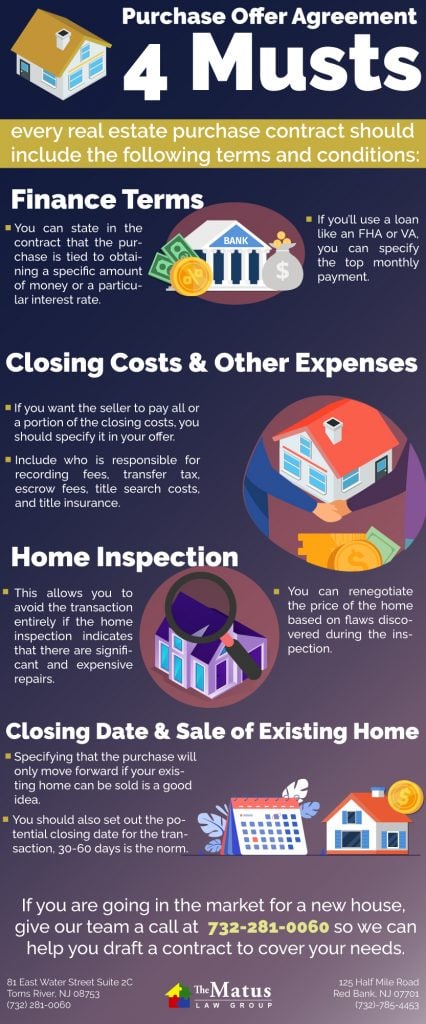
In addition to the terms of the offer, every real estate purchase agreement should also include:

  • Your financing contingency — If you are getting mortgage financing, you want your contract tied to your ability to get the appropriate financing. If you are applying for a VA or FHA loan, you can also specify the maximum payment you are willing to accept. If your financing doesn’t come through at these terms, you will be under no additional obligation under the purchase agreement. 
  • Closing costs and other expenses — Your purchase agreement should set out whether the seller has agreed to pay certain closing costs. It may also specify who will pay for things such as recording fees, transfer tax, escrow fees, title search costs, and title insurance.
  • Home inspection contingency — If a home inspection detects significant flaws in the home, you can avoid the purchase altogether or negotiate the price accordingly. 
  • Sale of your own home contingency — If you are relying on the sale of your existing home for this purchase, you can make the purchase contingent on the sale of that home.
  • Closing date — You should set out the potential closing date. This is typically 30 to 60 days from the signing of the purchase agreement, depending on your circumstances. 

Once all financing and other contingencies are satisfied and any title issues are cleared, your closing will be scheduled. In attendance will be the closing agent, you, the seller, and your respective attorneys. Here, all documents will be executed, closing costs paid , the deed will be signed and recorded, and you will get possession of your new home.  

Buying a new home is a large and expensive undertaking. Executing a legal contract for purchase should never be done without careful consideration. Having the advice and guidance of an experienced New Jersey real estate lawyer ensures that your purchase agreement is comprehensive and all its terms are in your best interest. At Matus Law Group, we can review your contract and guide you through your entire home-buying experience. Contact us to learn more.

What is a Tie In Agreement in Real Estate

A tie-in agreement, also known as a tying agreement, refers to a specific arrangement in real estate transactions where one party, usually a developer or seller, agrees to sell a property to a buyer on the condition that the buyer also utilizes the developer or seller’s services for another real estate transaction. These agreements can sometimes be viewed as a means to compel consumers to use or avoid specific services or products as a prerequisite for the transaction.

While some tying arrangements may be considered unlawful or abusive, many are legal and acceptable. To determine if a tie-in agreement is inherently unlawful, it must satisfy the following criteria:

  • Compelled purchase: The agreement requires the purchase of one item to acquire another desired item or service.
  • Substantial economic power: The seller possesses significant market influence over the tied product, thereby restricting free trade.
  • Foreclosure of market share: The agreement leads to the exclusion of a substantial portion of the market for the tied product.

Several types of tie-in agreements are commonly encountered in real estate transactions, including:

  • Broker Tie-Ins: Buyers may be encouraged or requested to engage the same broker for listing their home as they did for purchasing the property. This arrangement can benefit both parties by simplifying the transaction and providing the broker with opportunities to earn commissions from both the sale and listing. However, buyers are not obligated to use the same broker and are free to choose an alternative if desired.
  • Lender Tie-Ins: Developers or sellers may impose a requirement for buyers to secure a loan from a specific lender. This can safeguard the developer or seller against buyers who may struggle to obtain financing. Nonetheless, buyers are not obliged to use the designated lender and can opt for an alternative option.
  • Title Company Tie-Ins: Developers or sellers may stipulate that buyers must use a particular title company. This serves to protect the developer or seller from potential issues with underperforming title companies. Once again, buyers have the freedom to select a different title company if they so prefer.

While most tie-in agreements are legal, it is crucial to carefully evaluate them before entering into any contracts. Buyers and sellers should fully comprehend the type of tie-in agreement being employed and assess their comfort level with the arrangement. It is advisable to seek the guidance of an experienced New Jersey real estate attorney to review contracts containing tie-in agreements, ensuring compliance with relevant laws and regulations.

How Can a New Jersey Real Estate Lawyer Help

Understanding the differences between a purchase agreement and an offer is crucial for both buyers and sellers to ensure a smooth transaction process. By familiarizing oneself with the nuances of the real estate process, parties can avoid misunderstandings, protect their interests, and facilitate a successful property transfer.

To ensure that your real estate transaction proceeds smoothly and that all legal aspects are addressed, it’s critical to seek the legal help of a skilled New Jersey real estate lawyer. At The Matus Law Group, our team of New Jersey real estate attorneys may be able to provide invaluable assistance in reviewing and drafting purchase agreements, as well as ensuring that all parties are fully aware of their rights and obligations. Contact us today at (732) 281 – 0060 to schedule a consultation.

Inclusions in a Real Estate Purchase Agreement Description
Financing Contingency Specifies that the contract is dependent on the buyer’s ability to secure appropriate financing. It may also include the maximum payment the buyer is willing to accept. If financing is not obtained, the buyer is not obligated to proceed with the purchase.
Closing Costs and Other Expenses States whether the seller has agreed to pay certain closing costs. It may also outline the responsibilities for expenses such as recording fees, transfer tax, escrow fees, title search costs, and title insurance.
Home Inspection Contingency Allows the buyer to opt-out of the purchase or negotiate the price if significant flaws are discovered during the home inspection process.
Sale of Your Own Home Contingency Makes the purchase contingent upon the sale of the buyer’s existing home.


from Matus Law Group https://matuslaw.com/is-a-real-estate-purchase-agreement-the-same-as-an-offer/

Tips For The New Homeowner

Embarking on the home-buying journey is a significant milestone, often the result of years of hard work, savings, and careful planning. As a first-time homeowner, you are investing in your future, and it’s crucial to safeguard that investment by avoiding common first-time homebuyer mistakes. 

If you are ready to buy a home, an experienced real estate lawyer can help. At The Matus Law Group, our team of New Jersey real estate attorneys may be able to provide experienced guidance and ensure a smooth transaction. 

Keep Looking Towards The Future

When you move into a home, you want to make it yours. You can envision how you would redesign the kitchen and the bathrooms. Part of what makes owning a home so great is that it is yours. Don’t rush into significant renovations too quickly. 

After you have paid closing costs, attorney fees, and even the down payment, you may have less money than you’d expected. And this is common amongst first-time home buyers. You likely signed a 30-year mortgage. There will be time to renovate and design your house. The key is not to compromise your financial security and do it too quickly.

NJ real estate attorney

Build A Maintenance Schedule 

Though you are likely aware of this, it can still catch you off-guard. When something goes wrong in your house, you will have to oversee the repair. Whether your sink is clogged or the water heater fails, you will have to fix it.  

Build a list to check things monthly, quarterly, and annually. Most of these are preventative. Taking small steps can save money and time in the future. Every month, check your air filters. Keep spares on hand. You can flush your garbage disposal, check your fire extinguishers, ensuring your water heater isn’t leaking, and degreasing the hood vent in your kitchen. 

Save the more significant projects like clearing trees and shrubs away from your house, cleaning out the gutters, and checking your roof for your annual checks. 

Money-Saving Ideas

Because we started with the idea that you should save money by diving too quickly into costly renovations, it seems fitting that we suggest some ways to do that. 

You will learn a lot about your house after you move in. Before you purchased it, you likely did one or two tours and a final walk-through before closing. Some people ask to see heat and electricity bills during the home buying process to estimate utility costs. Look for ways to cut these costs and save money. 

When you move in, check the insulation in your attic. Gaps can allow valuable heat to escape, making your system work harder to maintain a temperature. Here are some other methods for saving money on your heating, cooling, and electrical bills:

  • Change out all your filters, especially those on the HVAC system 
  • Install LED light bulbs because they are more energy-efficient and will last longer. 
  • Putting in a SMART thermostat could cost hundreds of dollars, but it has the potential to save you as much too.
  • Do a quick search of your area and see what sort of incentives there are for installing energy-efficient devices in your home. Some states may subsidize the cost of these. 

Becoming a Homeowner

Prior to embarking on the journey of homeownership, it is crucial to equip yourself with the necessary information and readiness for the process. Owning a home can be an incredibly fulfilling life experience, but it’s important to be aware of the duties and effort required to preserve and enhance your valuable investment.

  • Understand Your Mortgage: 

Understanding your mortgage is crucial when becoming a homeowner. Make sure to familiarize yourself with the terms and conditions of your mortgage agreement, including the interest rate, length of the loan, and any prepayment penalties. 

  • Build an Emergency Fund:

As a homeowner, unexpected expenses are bound to occur. Whether it’s a broken appliance or a leaky roof, these repairs can be costly. It’s essential to have an emergency fund set aside for these situations.

  • Know Your Home’s Value:

Keep an eye on your home’s value by regularly checking the local real estate market and comparing your property with similar homes in the area. Understanding your home’s value will help you make informed decisions when it comes to refinancing, selling, or taking out a home equity loan.

  • Invest in Home Insurance:

Protect your investment by purchasing a comprehensive home insurance policy that covers your property and belongings.

  • Get Involved in Your Community:

Becoming a homeowner also means becoming a part of your local community. Engage in your community by becoming a member of neighborhood associations, participating in community events, and showing your support for local businesses.

Tips for the New Homeowner Description
Check air filters and HVAC system Regularly replace air filters in your HVAC system for proper airflow and improved air quality.
Flush garbage disposal Clean and maintain your garbage disposal by running water and disposing of ice cubes or citrus peels.
Check fire extinguishers Inspect fire extinguishers for damage, ensure they are fully charged, and replace if expired.
Check water heater and vents Inspect water heater for leaks or unusual noises. Clean and ensure proper ventilation of vents.
Clear trees, shrubs, and gutters Trim trees and shrubs near your house to prevent damage during storms or fire hazards. Clean gutters to avoid clogging and water damage to your home’s foundation.
Check roof and attic insulation Inspect roof for damage, missing shingles, or leaks. Assess attic insulation for gaps or heat loss. Improve insulation to reduce energy costs.
Electrical system inspection Hire a professional to inspect your electrical system, including outlets, for safety and proper functioning.

The Matus Law Group

If you are ready to buy a home, contact The Matus Law Group to schedule a consultation. We want you to feel comfortable and secure during your real estate transaction. In addition to protecting your interests, we are there to answer any questions you may have. We want you to sign your closing documents with confidence.


from Matus Law Group https://matuslaw.com/tips-for-the-new-homeowner/

How Escrow Works

Part of the reason people retain legal counsel during the home-buying process is that it can be a very complicated process. Buying or selling a home occurs in stages, and each one is very manageable. It takes a team of people to navigate through the process. That is why you must choose these people wisely—from your realtor to your lender and a New Jersey real Estate Attorney

Next, we want to look at one particular stage of the process: after the seller accepts the offer. There will be a relatively long period, perhaps a few months, that passes in between the seller accepting the offer and the buyer owning the home. Though several key things happen during this period, one critical piece is putting money into escrow.

The Basics

Because of the duration of the transaction, it is unrealistic to expect that no money should be exchanged or even put forth during this time. Think of escrow as a way to split the difference. The seller isn’t receiving money, but you aren’t holding onto it either. 

Your offer is just a formal document. If the seller accepts it, some of the components of that offer come into play. These include earnest money and your down payment. That money goes into an escrow account. This is an account managed by an outside party that doesn’t represent the buyer or the seller. Their job is to hold onto and safeguard the money that goes into it. Ultimately, if the real estate deal is successful, the seller will receive the funds in the escrow account, and the buyer will receive the property.

Why Is There a Need For an Escrow Account?

If this is your first time buying a house, you may not fully understand that there is a significant difference between pre-approval and final approval. Pre-approval can be done in a matter of minutes. Your report, in good faith, how much money you have, make, and wish to borrow. 

Your lender will approve or deny your request based on several factors, namely your debt-to-income ratio. To secure financing from your lender, you must provide all required documentation to verify what you declared in your pre-approval application. An escrow account allows a portion of your payment to be transferred while the seller waits for you to receive final approval from the lender.

Stages in Buying/Selling a Home Description Process
Pre-Approval Initial assessment of financial eligibility based on reported information Provide information on income, assets, and desired loan amount
Final Approval Verification of reported information and confirmation of financing Submit required documentation for verification
Escrow Account Temporary holding of funds during the final approval process Transfer a portion of payment to the seller while awaiting final approval

Escrow Disbursement

In the field of real estate, the process of escrow disbursement holds great importance as it involves the allocation of funds held in escrow to cover expenses such as homeowners insurance, property taxes, and other related costs. In New Jersey, it is common for lenders to require borrowers to deposit funds into an escrow account either during or after the closing of a property transaction, or when property expenses need to be settled.

The task of disbursing escrow funds is assigned to a neutral third party known as an escrow agent, who handles the payment of property expenses when they are due.

These escrow agents bear the responsibility of distributing funds from the escrow account according to their designated purposes. They are strictly prohibited from using the escrow funds for any purpose other than their intended use. For instance, funds placed in escrow by a buyer for mortgage payments cannot be utilized to cover homeowner’s insurance or property taxes, and vice versa. While escrow agents do not earn interest on the escrow funds, they may charge fees for their services.

Although not all escrow arrangements necessitate a written agreement, escrow agents must be diligent in adhering to written disbursement instructions. All escrow disbursements should be carried out in accordance with the specific date and method outlined by the owner of the escrow account. Failing to comply with the agreed-upon terms could lead to legal consequences.

The Matus Law Group

At the Matus Law Group, we aim to provide you with professional legal services while keeping you informed throughout the home-buying process. Buying or selling a home is a momentous occasion in your life. We want to enjoy this time, so allow us to protect your interests. Contact us to schedule a consultation!


from Matus Law Group https://matuslaw.com/how-escrow-works/

Monday, May 8, 2023

Do You Need A Home Inspector When Buying A House In New Jersey?

Buying a home is one of the largest investments of a lifetime for most people. And finding that special home is an exciting journey. But what lingers behind the facade of a house should not be a surprise after you have signed the paperwork and taken possession. Consequently, an experienced New Jersey real estate attorney would almost always advise about the benefits of having a professional home inspection completed prior to the closing of your new home.


While your seller is legally responsible for making disclosures about known deficits in the house, there are things that your seller may not even be aware of going on with the home. Although a home inspection is not legally required in New Jersey, it is one of the most important things when buying a house to ensure that it is free from mechanical and structural issues before signing on that dotted line.

What is the Difference Between an Inspection and an Appraisal?

A home inspection is a thorough investigation and evaluation of the home’s main structure and mechanical systems. The inspector goes through the home with the proverbial “fine-toothed comb” approach to ensure that there are no significant problems or deficits with it that may be of concern, either in the short-term or longer term. Although some sellers call for an inspection prior to listing the home, in most cases, this will be left up to a buyer after the contract.

An appraisal is a home assessment for the purposes of determining its fair market value. The mortgage company will require an appraisal to ensure that it is worth the price you are paying and the company is lending against. Although an appraisal will be extensive, it will not be extensive in the same way as a home inspection because its purpose is very different.

What Does a Home Inspector Look At?

A home inspector will be at the home for several hours, looking closely at each aspect of its construction and mechanical components, including all major appliances that are conveying. The home inspection will cover:

  • The exterior of the house
  • The foundation
  • The roof, including the support, covering, flashings, and gutters
  • The attic
  • Insulation
  • Electrical system, including wiring, outlets, and breakers
  • All visible plumbing, both inside and outside the home
  • Furnace, air conditioning, and any other HVAC components
  • Interior condition of the home
  • All appliances

What Fixes are Mandatory After a Home Inspection?

Although there are no legal obligations to rectify issues identified during a home inspection, certain problems may necessitate repairs to guarantee the safety and habitability of the property. Prospective buyers should prioritize fixes that address hazards such as:

  • Trip hazards
  • Pest or wildlife infestation
  • Significant structural issues
  • Building code violations
  • Mold or water damage
  • Toxic or chemical risks
  • Fire or electrocution risks

It’s important to note that cosmetic repairs and general wear and tear do not require attention from the seller, as they are considered the buyer’s responsibility. Moreover, buyers must distinguish between repairs they request and those mandated by a lender or insurance company for mortgage underwriting purposes.

New Jersey real estate attorney

In some cases, financial institutions or insurance providers may deny mortgage loans or coverage if they find the inspection results unsatisfactory. In such situations, the buyer must undertake specific mandatory fixes to secure a mortgage loan, particularly in states like New Jersey with stringent regulations.

By addressing these critical concerns, buyers can ensure they invest in a safe, habitable home, while sellers can enhance the likelihood of a smooth transaction. Tackling significant hazards not only safeguards all parties involved but also contributes to the overall improvement of the property’s quality. A thorough understanding of mandatory fixes and their implications can help both buyers and sellers navigate the home inspection process more effectively.

The Benefits of a Home Inspection

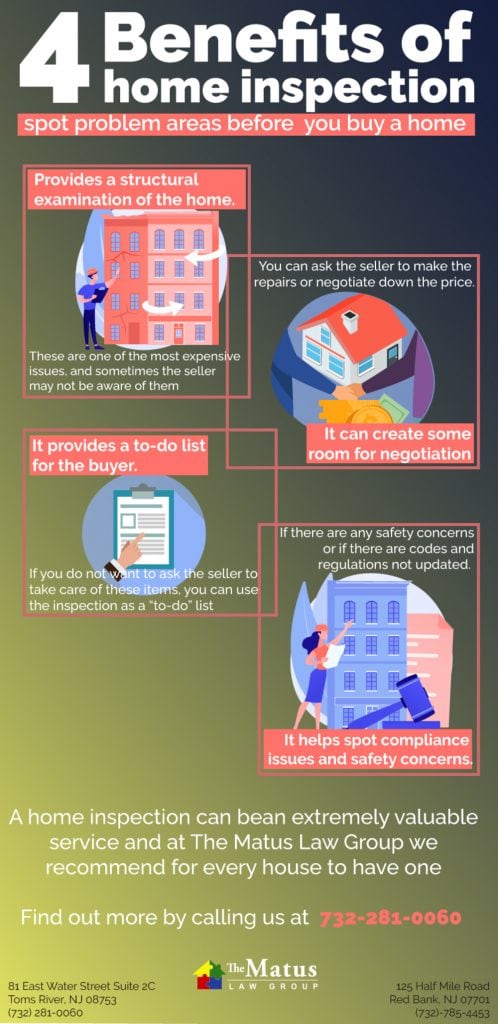
A professional home inspection can save a buyer hundreds if not thousands of dollars in unforeseen repair costs and allow an out if structural issues are found that he or she doesn’t care to inherit.

The home inspector is trained to find any faults in the home’s structure, code compliance issues, presence of current or previous water damage, mold, or other concerning conditions. Having a comprehensive home inspection completed offers the buyer the ability to ask for corrections from the seller or negotiate the price to offset any corrections the buyer will need to make.

Buying a home can be exciting and yet overwhelming. Having the advice of an experienced New Jersey real estate attorney offers peace of mind and ensures that there will be no lingering issues in your home-buying experience. At Matus Law Group, we will guide you through all facets of buying your new home. Contact us to learn more.

Home Inspection Appraisal
Purpose To identify any significant problems or deficits with the home To determine the fair market value of the property
Focus Main structure and mechanical systems of the home Overall value assessment of the property
Conducted by A professional home inspector A licensed or certified appraiser
Requested by Typically initiated by the buyer Usually required by the mortgage company or lender
Timing Often done after the contract is signed Usually performed during the mortgage application process
Extensiveness Thorough investigation with a fine-toothed comb approach Comprehensive evaluation, but not as detailed as a home inspection
Concerns Identifies potential problems or defects that need attention Determines if the property’s value supports the loan amount
Report Detailed report highlighting any issues or concerns found Detailed report including property information and appraised value
Cost Paid for by the buyer Paid for by the buyer or included in closing costs


from Matus Law Group https://matuslaw.com/do-you-need-a-home-inspector-when-buying-a-house-in-new-jersey/