
After tirelessly searching for the perfect home, you’ve finally found it! The next step is making an offer on the property. However, it’s important to remember that legally binding offers on real estate must be submitted in writing, not verbally.
Before moving forward, it’s crucial to have your real estate purchase agreement carefully reviewed by an experienced New Jersey real estate lawyer. This ensures that the purchase agreement is comprehensive and serves your best interests. At Matus Law Group, our team of New Jersey real estate attorneys may be able to help by reviewing your contract and guiding you through the entire home-buying process. Call us today at (732) 281-0060 and learn more about how we can help you.
What Information Must a New Jersey Real Estate Offer Include?
Your real estate offer will typically be drawn up by your real estate agent using the New Jersey Realtors® Standard Form of Real Estate Sales Contract. This form can also serve as your final real estate purchase agreement.

The contract should include the terms of your offer, including the price you are offering, your deposit amount, a potential closing date, what things you would like conveyed with the home, and any other contingencies you would like included.
What Must The Purchase Agreement Also Include?
Once the seller accepts your offer, it becomes your purchase agreement, and you have three business days to allow your New Jersey real estate attorney time to review its terms. During this time, either party can cancel the contract.
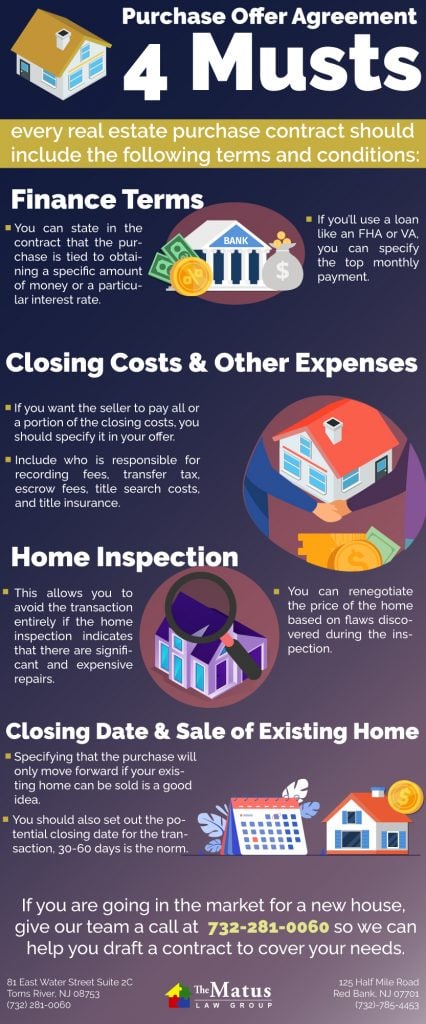
In addition to the terms of the offer, every real estate purchase agreement should also include:
- Your financing contingency — If you are getting mortgage financing, you want your contract tied to your ability to get the appropriate financing. If you are applying for a VA or FHA loan, you can also specify the maximum payment you are willing to accept. If your financing doesn’t come through at these terms, you will be under no additional obligation under the purchase agreement.
- Closing costs and other expenses — Your purchase agreement should set out whether the seller has agreed to pay certain closing costs. It may also specify who will pay for things such as recording fees, transfer tax, escrow fees, title search costs, and title insurance.
- Home inspection contingency — If a home inspection detects significant flaws in the home, you can avoid the purchase altogether or negotiate the price accordingly.
- Sale of your own home contingency — If you are relying on the sale of your existing home for this purchase, you can make the purchase contingent on the sale of that home.
- Closing date — You should set out the potential closing date. This is typically 30 to 60 days from the signing of the purchase agreement, depending on your circumstances.
Once all financing and other contingencies are satisfied and any title issues are cleared, your closing will be scheduled. In attendance will be the closing agent, you, the seller, and your respective attorneys. Here, all documents will be executed, closing costs paid , the deed will be signed and recorded, and you will get possession of your new home.
Buying a new home is a large and expensive undertaking. Executing a legal contract for purchase should never be done without careful consideration. Having the advice and guidance of an experienced New Jersey real estate lawyer ensures that your purchase agreement is comprehensive and all its terms are in your best interest. At Matus Law Group, we can review your contract and guide you through your entire home-buying experience. Contact us to learn more.
What is a Tie In Agreement in Real Estate
A tie-in agreement, also known as a tying agreement, refers to a specific arrangement in real estate transactions where one party, usually a developer or seller, agrees to sell a property to a buyer on the condition that the buyer also utilizes the developer or seller’s services for another real estate transaction. These agreements can sometimes be viewed as a means to compel consumers to use or avoid specific services or products as a prerequisite for the transaction.
While some tying arrangements may be considered unlawful or abusive, many are legal and acceptable. To determine if a tie-in agreement is inherently unlawful, it must satisfy the following criteria:
- Compelled purchase: The agreement requires the purchase of one item to acquire another desired item or service.
- Substantial economic power: The seller possesses significant market influence over the tied product, thereby restricting free trade.
- Foreclosure of market share: The agreement leads to the exclusion of a substantial portion of the market for the tied product.
Several types of tie-in agreements are commonly encountered in real estate transactions, including:
- Broker Tie-Ins: Buyers may be encouraged or requested to engage the same broker for listing their home as they did for purchasing the property. This arrangement can benefit both parties by simplifying the transaction and providing the broker with opportunities to earn commissions from both the sale and listing. However, buyers are not obligated to use the same broker and are free to choose an alternative if desired.
- Lender Tie-Ins: Developers or sellers may impose a requirement for buyers to secure a loan from a specific lender. This can safeguard the developer or seller against buyers who may struggle to obtain financing. Nonetheless, buyers are not obliged to use the designated lender and can opt for an alternative option.
- Title Company Tie-Ins: Developers or sellers may stipulate that buyers must use a particular title company. This serves to protect the developer or seller from potential issues with underperforming title companies. Once again, buyers have the freedom to select a different title company if they so prefer.
While most tie-in agreements are legal, it is crucial to carefully evaluate them before entering into any contracts. Buyers and sellers should fully comprehend the type of tie-in agreement being employed and assess their comfort level with the arrangement. It is advisable to seek the guidance of an experienced New Jersey real estate attorney to review contracts containing tie-in agreements, ensuring compliance with relevant laws and regulations.
How Can a New Jersey Real Estate Lawyer Help
Understanding the differences between a purchase agreement and an offer is crucial for both buyers and sellers to ensure a smooth transaction process. By familiarizing oneself with the nuances of the real estate process, parties can avoid misunderstandings, protect their interests, and facilitate a successful property transfer.
To ensure that your real estate transaction proceeds smoothly and that all legal aspects are addressed, it’s critical to seek the legal help of a skilled New Jersey real estate lawyer. At The Matus Law Group, our team of New Jersey real estate attorneys may be able to provide invaluable assistance in reviewing and drafting purchase agreements, as well as ensuring that all parties are fully aware of their rights and obligations. Contact us today at (732) 281 – 0060 to schedule a consultation.
| Inclusions in a Real Estate Purchase Agreement | Description |
|---|---|
| Financing Contingency | Specifies that the contract is dependent on the buyer’s ability to secure appropriate financing. It may also include the maximum payment the buyer is willing to accept. If financing is not obtained, the buyer is not obligated to proceed with the purchase. |
| Closing Costs and Other Expenses | States whether the seller has agreed to pay certain closing costs. It may also outline the responsibilities for expenses such as recording fees, transfer tax, escrow fees, title search costs, and title insurance. |
| Home Inspection Contingency | Allows the buyer to opt-out of the purchase or negotiate the price if significant flaws are discovered during the home inspection process. |
| Sale of Your Own Home Contingency | Makes the purchase contingent upon the sale of the buyer’s existing home. |
from Matus Law Group https://matuslaw.com/is-a-real-estate-purchase-agreement-the-same-as-an-offer/


No comments:
Post a Comment